Bianzan: on the Self and on Universality
Tadeus Pfeifer
An alphabet and a language to learn, a process of becoming conscious to follow, or perhaps to accompany, which from conception through birth leads to an existence that is more and more immersed in the reality of the world.
A process of becoming conscious of what is real, a process tending for the decades towards a search for an enrichment and a defense of one’s own interior harmony, which in this desire finds its justification.
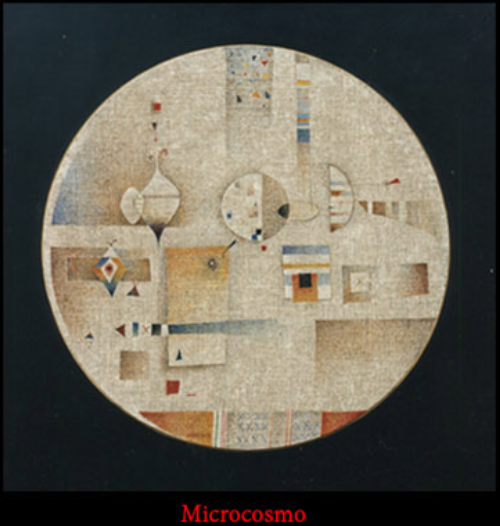
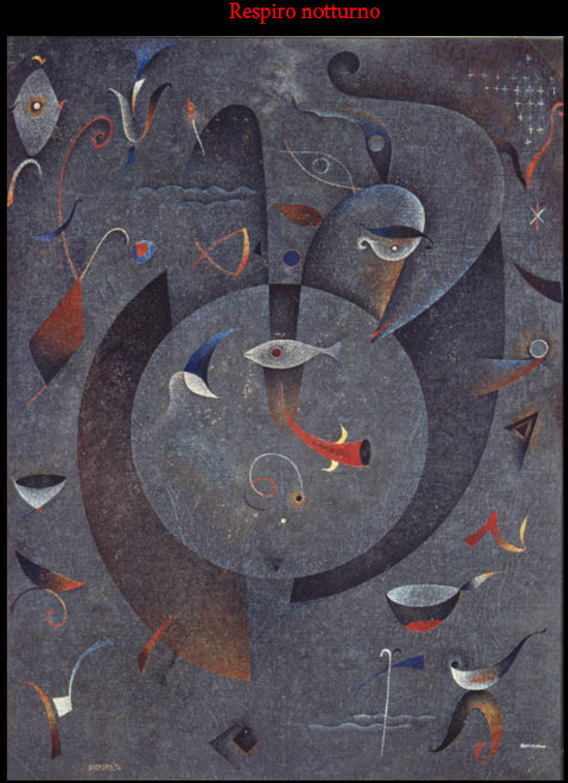
We have here the interior world of an artist, Bianzan, an alphabet and a language that allow us to follow the evolution of an individual “universe”; it contains suffering and pain, fateful events, music and mathematics, even a refined sense of irony that helps to control it even where one’s eyes dart in alarm. In her most recent works Bianzan’s pictorial work coalesces into unmistakable poetics. The forms that we see remind us only vaguely of the animal and plant world: a fish, a bird, an egg, a spermatozoon. The depicted event often takes place against a background of graphic signs, partly legible but often indecipherable: a kind of new life that germinates from the depths of a remote time.
We have here the interior world of an artist, Bianzan, an alphabet and a language that allow us to follow the evolution of an individual “universe”; it contains suffering and pain, fateful events, music and mathematics, even a refined sense of irony that helps to control it even where one’s eyes dart in alarm. In her most recent works Bianzan’s pictorial work coalesces into unmistakable poetics. The forms that we see remind us only vaguely of the animal and plant world: a fish, a bird, an egg, a spermatozoon. The depicted event often takes place against a background of graphic signs, partly legible but often indecipherable: a kind of new life that germinates from the depths of a remote time.
Quite often the circle is the ordering principle; it conserves, as if protecting it, its own metaphorical purity, in a context of events that without this limpid form would risk a fatal drifting away, because without the concept of perfection which they represent, without the presage of a total integration, each individual detail would be exposed to the seduction of chaos.
These fragments of life and of thought which condense and emerge alive from the work have been positioned with a careful and extremely sure hand. Their explicit meaning ought perhaps to be sought in a personal game, pure enchantment and magic; but more deeply they represent vital seeds from which the infinitive variety of forms develops, and if on the one hand they take shape delicately, on the other they vigorously reaffirm their immanent “yearning for form”.
One might look upon Bianzan’s paintings as precisely outlined dreams or as oneiric proposals for the observer to continue dreaming, presented by the artist according to the rich play of fantasy that is revealed moment by moment through the creative improvisation of the work.
Wide worlds and new itineraries open up to those who discover and learn the oneiric language of Bianzan. Every painting symbolizes the atmosphere of one of the four elements, and the observer can serenely and confidently let himself be carried into watery environs, into the gloomy bowels of the earth, into the incandescent, living fire or into airy spaces.
Taken individually Bianzan’s paintings, refined in their composition and spatially allusive to ever vaster realities, could be viewed as details of a single composition that embraces the whole “world”. In its varied stratifications each painting could be a tile in mosaic that completes a sweeping panorama “inhabited” by the observer with the participation of all his senses. He perceives two matrices in the event portrayed in the painting: one which recalls things known, things familiar, the other which, under the effect of the first matrix, leads the observer emotively towards something that he doesn’t know – or doesn’t know yet. What? His own self.
These fragments of life and of thought which condense and emerge alive from the work have been positioned with a careful and extremely sure hand. Their explicit meaning ought perhaps to be sought in a personal game, pure enchantment and magic; but more deeply they represent vital seeds from which the infinitive variety of forms develops, and if on the one hand they take shape delicately, on the other they vigorously reaffirm their immanent “yearning for form”.
One might look upon Bianzan’s paintings as precisely outlined dreams or as oneiric proposals for the observer to continue dreaming, presented by the artist according to the rich play of fantasy that is revealed moment by moment through the creative improvisation of the work.
Wide worlds and new itineraries open up to those who discover and learn the oneiric language of Bianzan. Every painting symbolizes the atmosphere of one of the four elements, and the observer can serenely and confidently let himself be carried into watery environs, into the gloomy bowels of the earth, into the incandescent, living fire or into airy spaces.
Taken individually Bianzan’s paintings, refined in their composition and spatially allusive to ever vaster realities, could be viewed as details of a single composition that embraces the whole “world”. In its varied stratifications each painting could be a tile in mosaic that completes a sweeping panorama “inhabited” by the observer with the participation of all his senses. He perceives two matrices in the event portrayed in the painting: one which recalls things known, things familiar, the other which, under the effect of the first matrix, leads the observer emotively towards something that he doesn’t know – or doesn’t know yet. What? His own self.
Tadeus Pfeifer
(Basel, September 1992)
Tadeus Pfeifer, born in 1949 in Freiburg, in the former Federal Republic of Germany, lives in Basel, Switzerland. A writer and journalist, he has published several volumes of poetry and novels (the complete works are edited by Literaturverlag, Karlsruhe). An art critic, he collaborates with several newspapers and art magazines. He has also published essays and monographs on contemporary artists.

