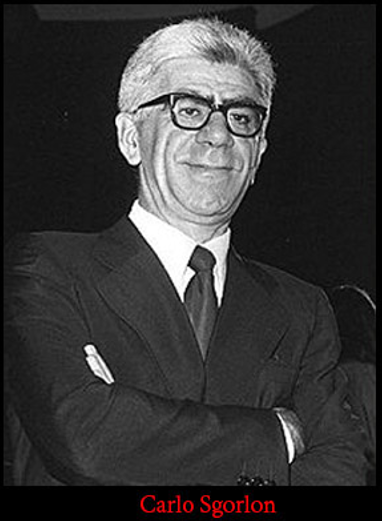
Carlo Sgorlon
… they are damned come out from who knows where, wandering the world, mingling with the living in the hour of phantoms and visions. Of what are they messengers? Of fear? Of distorted moral deformations that lurk in men less and less secretly? Perhaps of one and the other together, sinisterly mixed. Fear, moral distortion and epiphany of the negative increasingly break thorough the crust of conventions and of civilizations, to run rampant among us. It may be the artist’s own fear, her attempt to exorcise it, by tearing away the filaments among which she has struggled since childhood, ever since she saw, at a very young age, her grandfather slaughtered by disbanded German soldiers, fleeing on the roads of the North. It may be fear of the cosmic, irrational forces, whose small or large explosions we continually witness. Fear, often aggressive, due to excessive defense, may be the hands of the figures. Hands that are rapacious, griffin-like, with evident tendons, thin flesh-less muscle bundles, traversed by irresistible nerve impulses. Hands of figures turned to stone by the sight of mysterious jellyfish. Hands studied in their functions and anatomical structures to the point of recalling some drawings by Leonardo. One seems to catch in Bianzan a memory of the anatomical wonders that the great painters of Renaissance, from Tura to Mantegna, from Leonardo to Michelangelo, used to explore in the dynamics of the human body. The negative of man does not resonate forever. Groups of melancholic figures come forward, united by affectionate attitudes.
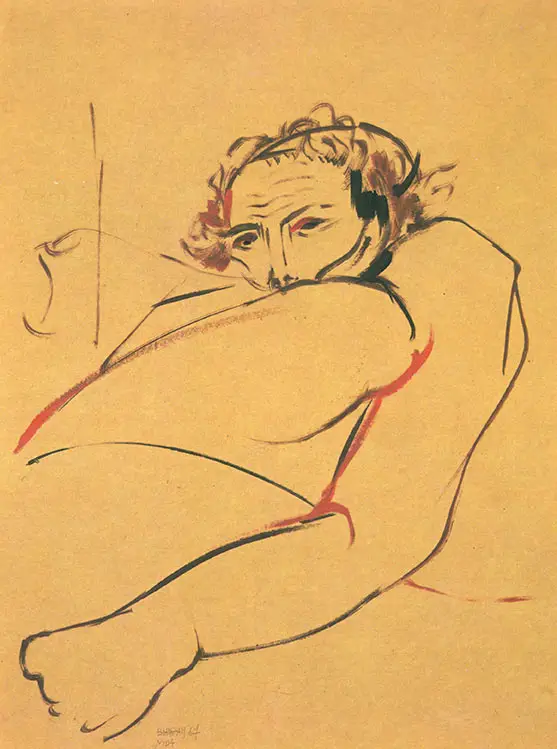
They are family groups, motherhood, women and men defined in their mighty corporeity, but also fragile, as they are traversed by melancholy and poignant sweetness.
We seem to glimpse vague memories of the drawings of the beloved Picasso, a master of feelings and signs rather than poets. The emotional world of Bianzan is also defined in the bodies, all disarmed, vulnerable and as if ashamed of their monumentality. These drawings testify the awareness of a surviving piety, which prevents the artist from descending the ravine to the extreme and induces her to stop where the cries of tragedy do not reach. It is at the end of the 1960s that the endless, distraught crowds inhabiting Dante’s circles appear, crowds that thronged along the banks of the Acheron, or run after the flags that did not have in life in the host of the sloth, or they are overwhelmed by the infernal storm. Swarms and festoons of breathless bodies, myriads of poor bodies in which individuality is lost in the anonymity and acephalous animality of the mass. From it can only arise evil, violence, brutality, rage, fury, total degradation. The spirit is extinguished. There is only organic, brutal survival, with the triumph of the herd and its most deteriorating and inhuman qualities. But sometimes the crowds separate into small groups. The figures slump in biblical desolations, or huddle in themselves in desperate solitudes or are traversed by Bosch-like monsters, improbable birds that elude any classification, loading themselves with symbolic meanings.
Carlo Sgorlon
Venice