Bianzan’s drawing and painting
Raffaele De Grada
Bianzan was born in Friuli, a land severly punished by two wars that opposed the Germanic and to the Latin world, but these are ancestral memories that, however surface in her imagination, judging from the drawings of the Sixties with which she began her artistic career.
They were drawn with the tip of the pen, and tell of fabulous begin that grant nothing to the easy solutions of the informal; they seem to be blown by “the infernal squall that is never calmed”, in an agitation that is not consumed by being drawn but everlastingly points to a new different image. It is this precision of profiles in the tangle of strange tales which is most impressive in Bianzan’s art, a precision borne out by titles that are unambiguous, yet extraordinary.
The drawings of Bianzan in their visionary reality have a quite precise sense of form. They can be variously interpreted: many years ago (1976) Carlo Castellaneta saw them as a “hallucinated gallery, a mythology of horror, a tale of our daily anguish”. Certainly they go against the taste for beauty such as yet prevailed with us until a few years ago: passing scenes of wild, convulsive flight, bodies agglomerated in Dantesque clouds.
What is the origin of these figures? Carlo Sgorlon refers back to a grandfather cut down by disbanded German soldiers fleeing at the end of the war. These memories surely influenced Bianzan’s childhood, but this would not have been possible without the period of advanced decadence that we have recently experienced and are still experiencing. This could have been conveyed with the realistic harshness that has been adopted by many artists of our time and that in Bianzan is totally missing.
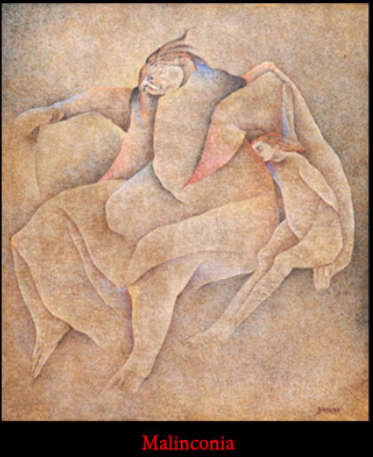
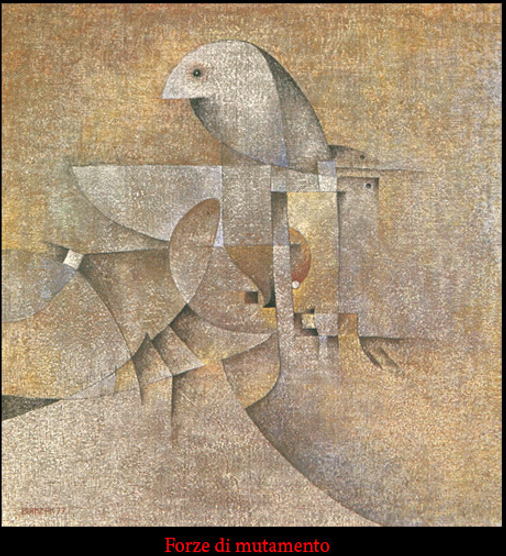
Bianzan has thus attempted in painting an irrational flight from this our world and, without abandoning the ethical involvement that is revealed in her drawings, she has given free access to visions painted with a language that recalls the masters of cubism and the great Paul Klee.
They were drawn with the tip of the pen, and tell of fabulous begin that grant nothing to the easy solutions of the informal; they seem to be blown by “the infernal squall that is never calmed”, in an agitation that is not consumed by being drawn but everlastingly points to a new different image. It is this precision of profiles in the tangle of strange tales which is most impressive in Bianzan’s art, a precision borne out by titles that are unambiguous, yet extraordinary.
The drawings of Bianzan in their visionary reality have a quite precise sense of form. They can be variously interpreted: many years ago (1976) Carlo Castellaneta saw them as a “hallucinated gallery, a mythology of horror, a tale of our daily anguish”. Certainly they go against the taste for beauty such as yet prevailed with us until a few years ago: passing scenes of wild, convulsive flight, bodies agglomerated in Dantesque clouds.
What is the origin of these figures? Carlo Sgorlon refers back to a grandfather cut down by disbanded German soldiers fleeing at the end of the war. These memories surely influenced Bianzan’s childhood, but this would not have been possible without the period of advanced decadence that we have recently experienced and are still experiencing. This could have been conveyed with the realistic harshness that has been adopted by many artists of our time and that in Bianzan is totally missing.
Bianzan has thus attempted in painting an irrational flight from this our world and, without abandoning the ethical involvement that is revealed in her drawings, she has given free access to visions painted with a language that recalls the masters of cubism and the great Paul Klee.
At first in the Seventies she seemed to undergo the influence of the surrealist school: a colored dream in which Bosch-like animals disturbed the human imagination. From deep within Bianzan, as in a medieval fresco, strange visions of the blessed and the damned come to the surface, visions composed of slender grey and flesh-colored things that are calmed into visions which, far from being anguished, are rather classical. On an obviously different scale, one can sense the extraordinary influence of Picasso. One feels that these painted visions are sustained
by a mastery of drawing and are above all heavy with the soul that so many contemporary artists, even the considerable fame, have lost. Thus has often happens, Bianzan has two souls: one is her drawing, into which the artist pours her own existential drama; the other is her painting, where the austere sweetness of colour sustains soothing contents.
In the midst of the many offerings that also in Italy crowd the exhibition halls, this from Bianzan, an artist not well known among us, seems to be rather exceptional. To call her a surrealist is only bureaucratic diction that does not serve to explain all the repertory of dreams that haunt the universe of Bianzan, who is a true “maestro”. For what the opinion of a critic who has known her work only for a short time is worth, I believe that this artist ought to be set on a very high plane. Also among us new languages appear, previously unknown, but such as to enrich our heritage of knowledge. Deciphering the dreams of an artist like this is like reading a text of medieval miniatures. Each page is a discovery, a cryptic but fascinating proposition, with a quality of painting that must be placed above the national level. Fortunately Italian culture is realizing this, and we are very pleased to call attention to this exceptional presence.
In the midst of the many offerings that also in Italy crowd the exhibition halls, this from Bianzan, an artist not well known among us, seems to be rather exceptional. To call her a surrealist is only bureaucratic diction that does not serve to explain all the repertory of dreams that haunt the universe of Bianzan, who is a true “maestro”. For what the opinion of a critic who has known her work only for a short time is worth, I believe that this artist ought to be set on a very high plane. Also among us new languages appear, previously unknown, but such as to enrich our heritage of knowledge. Deciphering the dreams of an artist like this is like reading a text of medieval miniatures. Each page is a discovery, a cryptic but fascinating proposition, with a quality of painting that must be placed above the national level. Fortunately Italian culture is realizing this, and we are very pleased to call attention to this exceptional presence.
Milan
Raffaele De Grada