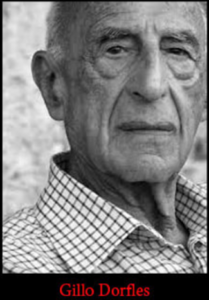
Gillo Dorfles
Bianzan
There are not many artists, especially nowadays, who manage to be autonomous, without drawing inspiration and style from the greats of the past or present. Bianzan belongs to this small group of solitary inventors of both a specific technique and a highly original figuration. It is undeniable that the technique often constitutes a premise even for the images intended to be developed on canvas; and in the case of Bianzan the way in which her canvases are modulated, already constitutes an example of an autonomous will to realize. The canvases, worked with thin layers of acrylic, vinyl colors, offer an example of extreme vibration of color and they are the necessary matrices for her fantastic figurations that, only through this refined technique, reach the most complete expressive effectiveness. But, at this point, we must analyze the ideational aspect of these original paintings and drawings. Already in the large series of these latter – for example those inspired by the Divine Comedy – the artist’s touch appears to be of such incisiveness and perfection that it gives the scenes a kind of “aerial credibility”. They are scenes where the fancy of the image is accompanied by a very personal interpretation of the poem, certainly very far from Dante’s! But charged with symbolic stimulation, revealing an intimate participation in the work itself.
Approaching the canvases – some of large dimensions but always painted with the same refined technique – we find ourselves confronted with the presence of a true “ imaginative universe” of incredible complexity, through which the artist has achieved a kind of constant surreality (which should not be equated with traditional surrealism). The works created by Bianzan are sometimes the “transfigurations” of experienced scenes, where human figures undergo unusual metamorphoses, other times they border on the drafting of real inventions of unpredictable fantastic beings belonging to a utopian “animality” or “vegetality”. To mention but a few of the many examples, see “the Idol of Fire 1991”, an abysmal panorama where a series of pseudo-animals ogle in an undifferentiated magma; or “Rustic Fable”, where a human-looking figure presents body parts with animal identities. But any description of these works would sound false and approximate, as in the case of “Labyrinths of 2003”, a canvas entirely set on blue and where mysterious identities involve the very fabric of firmament. Here, then, is how the encounter, between a peculiar painting technique and an inexhaustible imagination, allows the artist to create a work that – as I stated from the beginning
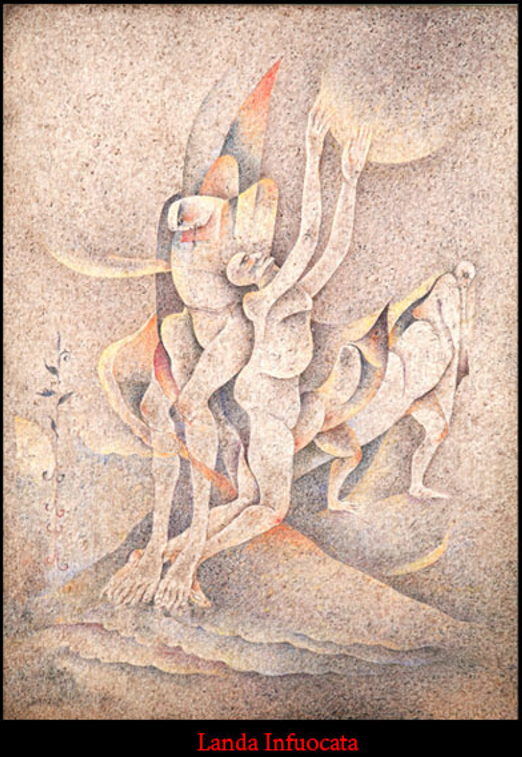
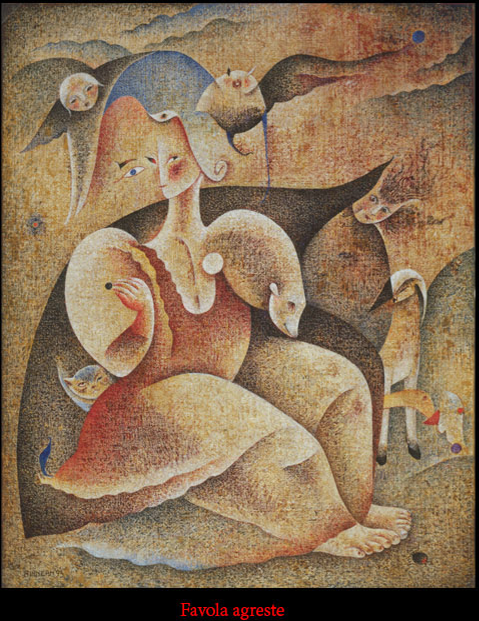
– is undoubtedly autonomous in its expressive realization and original iconology: these anthropomorphic beings, these nonexistent vegetables, these protoplasmic entities where the absurd and the Unnheimlich triumph, are far from any other vision. And, indeed, the allusion to Bosh and Brueghel (already attempted by some critics), is only partially acceptable because Bianzan’s inventions transcend all representational realism (always present in the great Flemish artists). The beings, immersed in their organic plasma, present a metamorphic vitality that allows no derivation; not only but, it is precisely the iridescent chromatic magma that offers these “zoomorphic creatures” an atmosphere between magical and frightening that always makes them mysterious and elusive.
Gillo Dorfles
Milan September 28, 2009

