Bianzan
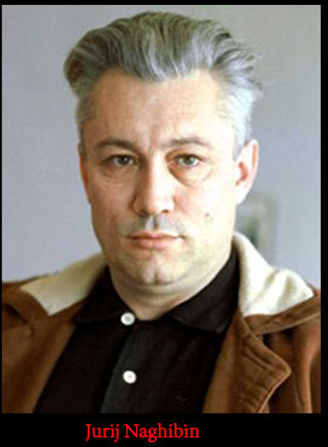
Jurij Naghibin
Jurij Naghibin, born in Moscow in 1920, is a writer and film scriptwriter (1981 Oscar winner for Kurosawa’s Dersu Uzala); he is the most famous and discussed of the representatives of that gene- raction of authors who came to prominence in the former Soviet Union after World War II. He has published more than forty books, many translated into various languages. A passionate connoisseur of painting, he has written numerous essays on well-known artists, including Chagall and Tintoretto, which have also been published in Italy.
When looking at the original works of Bianzan, I love to savor this art that, amoeba-like undergoes continuous transformations; but my preference goes to the drawings, which I consider closer to my thoughts.
Bianzan’s art does not submit to tests of realism that put the image into confrontation with nature so that, once the artist’s purpose has been revealed, it is possible to grant or deny him our confidence.
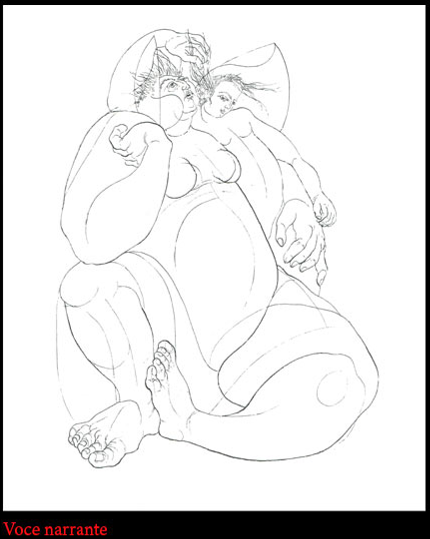
Here everything must be accepted as it is in religious faith, where the incontestable existence of God has no need of proof in order to be demonstrated, even though we feel the desire to understand why we are attracted by the perturbing, deformed creatures that animate these works and possess a strange, almost irritating beauty. They are asexual beings with potent, incorporeal bodies, skin-covered containers with human traits sometimes, lost in pensive dreams, in drowsiness populated by oppressive fantasies or in resigned suffering.
When looking at the original works of Bianzan, I love to savor this art that, amoeba-like undergoes continuous transformations; but my preference goes to the drawings, which I consider closer to my thoughts.
Bianzan’s art does not submit to tests of realism that put the image into confrontation with nature so that, once the artist’s purpose has been revealed, it is possible to grant or deny him our confidence.
Here everything must be accepted as it is in religious faith, where the incontestable existence of God has no need of proof in order to be demonstrated, even though we feel the desire to understand why we are attracted by the perturbing, deformed creatures that animate these works and possess a strange, almost irritating beauty. They are asexual beings with potent, incorporeal bodies, skin-covered containers with human traits sometimes, lost in pensive dreams, in drowsiness populated by oppressive fantasies or in resigned suffering.
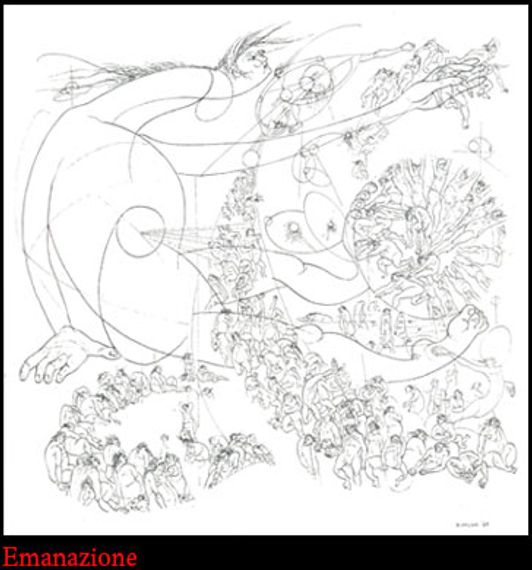
These being, like Dantesque martyrs, are imprisoned in rock or in ice or swept up by spirals of whirling winds that bring to mind the first circle of Hell, where an endless swirling imprisons and punishes lovers who have broken the laws of morality.
It is wonderful to see the absurd senselessness of these naked, often contorted bodies burdened with overwhelming violent expressiveness as they advance, and crush, and oppress. Are they aware of what awaits them? Why are they so distressed? Why do they flee as if the ground were incandescent? Their anguished movement has no sense, as there is no sense to the anxiety of the Kafkian character who sought without reason to enter into the mysterious castle. Isn’t this the fate of all of us who vainly waste our vital energy chasing after deceitful social, political, moral and aesthetic chimeras? But unfortunately that is how we are, when in the pursuit of our empty shams, bound to the hard ground or anchored to a helpless desperation we exhaust our useless kinetic energy. What elements therefore make for the fascination of this graphic art that incarnates the triumph of the absurd? It can be compared to the etchings of Goya, but the style is completely different from “Los caprichos”, born of the will to strike at the vices of humanity with lashing allusions; Bianzan does not judge, does not pose ethical problems. For the same reasons we cannot turn to deeply religious artists such as Hieronymus Bosch and Pieter Bruegel, because moral principles inspire the monstrous deformities of the beings that populate their works. Not that Bianzan’s art is against morality: it simply stays outside. Bianzan belongs to the line of artist that does not ask questions about the relationship between morality and art. Théophile Gautier’s theory of art for art’s sake,
It is wonderful to see the absurd senselessness of these naked, often contorted bodies burdened with overwhelming violent expressiveness as they advance, and crush, and oppress. Are they aware of what awaits them? Why are they so distressed? Why do they flee as if the ground were incandescent? Their anguished movement has no sense, as there is no sense to the anxiety of the Kafkian character who sought without reason to enter into the mysterious castle. Isn’t this the fate of all of us who vainly waste our vital energy chasing after deceitful social, political, moral and aesthetic chimeras? But unfortunately that is how we are, when in the pursuit of our empty shams, bound to the hard ground or anchored to a helpless desperation we exhaust our useless kinetic energy. What elements therefore make for the fascination of this graphic art that incarnates the triumph of the absurd? It can be compared to the etchings of Goya, but the style is completely different from “Los caprichos”, born of the will to strike at the vices of humanity with lashing allusions; Bianzan does not judge, does not pose ethical problems. For the same reasons we cannot turn to deeply religious artists such as Hieronymus Bosch and Pieter Bruegel, because moral principles inspire the monstrous deformities of the beings that populate their works. Not that Bianzan’s art is against morality: it simply stays outside. Bianzan belongs to the line of artist that does not ask questions about the relationship between morality and art. Théophile Gautier’s theory of art for art’s sake,
repeatedly defeated in the past, here seems victorious. But I remember that Baudelaire, Gautier’s contemporary, once wrote: “I do not wish to maintain that poetry does not ennoble behavior – understand me well – but to believe that the purpose of art is to raise man above his mean interests would be absurd.”
These statements show clearly what kind of art arouses my admiration: that which ultimately has a scope, albeit concealed. For this reason I agree with Baudelaire. But then why do I like Bianzan’s work? I simply like it, that’s all! If art needs no explanations, then neither does the love that art produces need to be justified. But I cannot bear to be so blissfully irresponsible; I feel obliged to look for a reason.
In Bianzan I am enchanted by the magic purity of the line: how light, exquisite, elegant and strong at the same time is her drawing! At times it is grandiose; some of her figures are titans capable of lifting the vault of heaven or the globe of the earth, delineated with a single airy wave of the hand; if we were forced to make comparisons with regard to her stroke we would have to refer to Picasso (without this meaning imitation).
These works, dominated by a strong aesthetic sense, satisfy our desire for beauty and thus “ennoble behavior”. Furthermore they are dear to the heart of one who, like me, has a pragmatic attitude towards art.
These statements show clearly what kind of art arouses my admiration: that which ultimately has a scope, albeit concealed. For this reason I agree with Baudelaire. But then why do I like Bianzan’s work? I simply like it, that’s all! If art needs no explanations, then neither does the love that art produces need to be justified. But I cannot bear to be so blissfully irresponsible; I feel obliged to look for a reason.
In Bianzan I am enchanted by the magic purity of the line: how light, exquisite, elegant and strong at the same time is her drawing! At times it is grandiose; some of her figures are titans capable of lifting the vault of heaven or the globe of the earth, delineated with a single airy wave of the hand; if we were forced to make comparisons with regard to her stroke we would have to refer to Picasso (without this meaning imitation).
These works, dominated by a strong aesthetic sense, satisfy our desire for beauty and thus “ennoble behavior”. Furthermore they are dear to the heart of one who, like me, has a pragmatic attitude towards art.
repeatedly defeated in the past, here seems victorious. But I remember that Baudelaire, Gautier’s contemporary, once wrote: “I do not wish to maintain that poetry does not ennoble behavior – understand me well – but to believe that the purpose of art is to raise man above his mean interests would be absurd.”
These statements show clearly what kind of art arouses my admiration: that which ultimately has a scope, albeit concealed. For this reason I agree with Baudelaire. But then why do I like Bianzan’s work? I simply like it, that’s all! If art needs no explanations, then neither does the love that art produces need to be justified. But I cannot bear to be so blissfully irresponsible; I feel obliged to look for a reason.
In Bianzan I am enchanted by the magic purity of the line: how light, exquisite, elegant and strong at the same time is her drawing! At times it is grandiose; some of her figures are titans capable of lifting the vault of heaven or the globe of the earth, delineated with a single airy wave of the hand; if we were forced to make comparisons with regard to her stroke we would have to refer to Picasso (without this meaning imitation).
These works, dominated by a strong aesthetic sense, satisfy our desire for beauty and thus “ennoble behavior”. Furthermore they are dear to the heart of one who, like me, has a pragmatic attitude towards art. The beautiful, deformed creatures that populate Bianzan’s white sheets of paper act on man’s behalf by exercising an influence that is beneficial even if uninvited. Her art forces us to look carefully within ourselves, it unveils our hidden secrets and it leads us involuntarily to reflect on the existence and destiny of man.
God created Adam in his image and likeness only exteriorly, and Adam, spiritually imperfect, fatally sinned. Down through thousands of years we have further degraded ourselves: how many frog people, hippo people, jackal people around us! Interiorly we have turned Adam’s paltry sin into something enormous. Perhaps we are only the raw material from which true human beings will be moulded. For the time being, as wretched bipeds we remain more similar to the fantastic figures of Bianzan than to the unfallen Adam or the Adam of the future. In looking at these works we feel penetrated by the pain hidden in them; these creatures are, like all of us, the step-children of humanity. The almost ashamed admiration which these drawings arouse is similar to the feeling we have when we look at our images reflected in a curved mirror. The suspicion arises in us that the deformed face we see is our real face. Normal mirrors flatter us the same way in which the miniaturist Liotard flattered his models.
I am aware of the critical judgments made on the artist activity of Bianzan. Sometimes rightly and sometimes not these judgments evoke the names of Dante and Kafka, Leonardo da Vinci and Michelangelo, Bosch and Bruegel, Goya and Picasso, Klee and Buzzati; they do not call upon Miro’, to whose works the paintings of Bianzan are akin. The roots from which this art draws its nourishment reach down into the culture of Mitteleuropa, but in these critical writings I have vainly looked for a comment that might capture the essence of the results obtained by the creative search undertaken by this artist.
These statements show clearly what kind of art arouses my admiration: that which ultimately has a scope, albeit concealed. For this reason I agree with Baudelaire. But then why do I like Bianzan’s work? I simply like it, that’s all! If art needs no explanations, then neither does the love that art produces need to be justified. But I cannot bear to be so blissfully irresponsible; I feel obliged to look for a reason.
In Bianzan I am enchanted by the magic purity of the line: how light, exquisite, elegant and strong at the same time is her drawing! At times it is grandiose; some of her figures are titans capable of lifting the vault of heaven or the globe of the earth, delineated with a single airy wave of the hand; if we were forced to make comparisons with regard to her stroke we would have to refer to Picasso (without this meaning imitation).
These works, dominated by a strong aesthetic sense, satisfy our desire for beauty and thus “ennoble behavior”. Furthermore they are dear to the heart of one who, like me, has a pragmatic attitude towards art. The beautiful, deformed creatures that populate Bianzan’s white sheets of paper act on man’s behalf by exercising an influence that is beneficial even if uninvited. Her art forces us to look carefully within ourselves, it unveils our hidden secrets and it leads us involuntarily to reflect on the existence and destiny of man.
God created Adam in his image and likeness only exteriorly, and Adam, spiritually imperfect, fatally sinned. Down through thousands of years we have further degraded ourselves: how many frog people, hippo people, jackal people around us! Interiorly we have turned Adam’s paltry sin into something enormous. Perhaps we are only the raw material from which true human beings will be moulded. For the time being, as wretched bipeds we remain more similar to the fantastic figures of Bianzan than to the unfallen Adam or the Adam of the future. In looking at these works we feel penetrated by the pain hidden in them; these creatures are, like all of us, the step-children of humanity. The almost ashamed admiration which these drawings arouse is similar to the feeling we have when we look at our images reflected in a curved mirror. The suspicion arises in us that the deformed face we see is our real face. Normal mirrors flatter us the same way in which the miniaturist Liotard flattered his models.
I am aware of the critical judgments made on the artist activity of Bianzan. Sometimes rightly and sometimes not these judgments evoke the names of Dante and Kafka, Leonardo da Vinci and Michelangelo, Bosch and Bruegel, Goya and Picasso, Klee and Buzzati; they do not call upon Miro’, to whose works the paintings of Bianzan are akin. The roots from which this art draws its nourishment reach down into the culture of Mitteleuropa, but in these critical writings I have vainly looked for a comment that might capture the essence of the results obtained by the creative search undertaken by this artist.
Perhaps the reasons for things should never be asked, just as nothing should be asked of the Creator. All of this brings back to my mind the refined thought game splendidly expressed by Osip Mandelshtam: “Remain foam, O Aphrodite, and the world will turn back into sound.” And the words of Pasternak: “Silence: it is the best thing I have heard”. But in this dread century, frightening and explosive, I prefer the black bread of art: a word, not silence; a goddess, not foam; a moan of love, a cry of pain, a call for help, not deathly silence. The attempt t
o arrive at the meaning of things, at the discovery of the mystery, and not the useless deception of the poor, bewildered human brain.
The artist needn’t worry about the meaning and the purpose of his explorations, but since he has to speak of the created world, he must above all hear the suffocated cry that comes from the depth of the soul and often emerges as a prayer implorin
g salvation. It could be that we artists can still manage to do something before all the voices in the world together cry out too late their Sos! These are the thoughts and the feelings produces in my tired heart by the works of Bianzan; I know that according to the rules of good manners her works should have inspired silence, because by themselves they are precious even without words. But contrary to what the Russian proverb says, I am the hunchback who doesn’t straighten out even in the gravThe artist needn’t worry about the meaning and the purpose of his explorations, but since he has to speak of the created world, he must above all hear the suffocated cry that comes from the depth of the soul and often emerges as a prayer implorin
e.
Jurij Naghibin
Moscow

