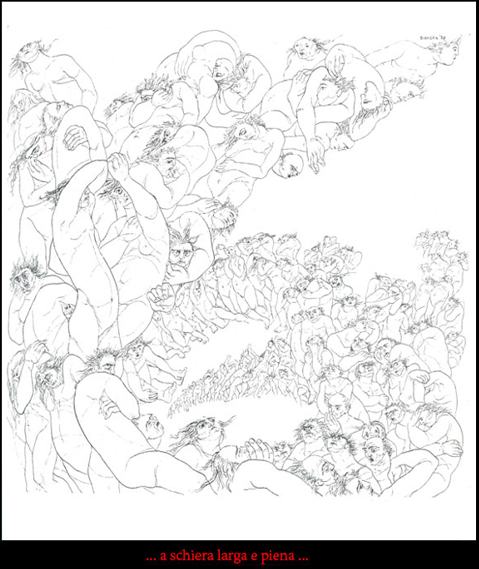
Each of Bianzan’s paintings is like an x-ray of our soul. It describes what the eye fails to grasp, but it is not mere fantasy, whim of the imagination, extravagance. The connection goes to the great season of the “visionary painters”, especially to the English of the early nineteenth century, Fuessli and Blake; then encountering a sensitive like Odilon Redon, undergoing the suggestion of the Surrealists, and then reaching Klee and Mirò… But that is not enough. It is science that is the main flywheel: biological and chemical science showing, through electron microscopes, the most hidden ganglia of microorganism life. Here, on the slides of histological findings, science and painting nearly touch each other. Original life, corpuscles vibrating in space, chromosomes guarding the rules of the Great Mystery: a moment of revelation for us, a plunge into the heart of the world. Bianzan is there: capturing, as in a secret snapshot, the primary signs of life.Bianzan’s painting should be viewed from this angle. The aesthetic aspect is, surely, an important component of it: just observe with what finesse is rendered the surfacing of primary forms in the dark labyrinths of genetic memory. The sign becomes a vehicle of the imaginary; the color melts into delicate marbling; and an arcane atmosphere slips among clots enhanced by amoebic forms. But the fascinating of painting is not only here. It lifts, with extreme modesty, the flaps of a skin that envelops our sensory “asperience”; and digs within, with a surgeon’s scalpel, in search of the primary nexuses, the knots in which dreams are wrapped, the marvelous archetypes of our
subconscious.
Here the case, into which the journey into the unknown seemed to plunge, gives way to a different order: the order that Luca Pacioli intuited in the 15th century, when he sought to reweave the threads of mathematics and art in the name of a neoplatonic ideal. Not the classical order: but the biological order of the world. What was not reducible to a theorem is suddenly fixed by the images of painting, which proceeds intuitively. It is here that we recognize the beauty-truth of Bainzan’s painting. It seems to go beyond the parameters of our rationality, immersing itself in the labile currents of time …. Instinct and intellect, sense and reason, nature and structure merge: the extremes touch each other, combine. Bianzan manages to compose her landscapes of the spirit by juxtaposing fragments of a memory rich in cultural suggestions. But her magmatic terrain is always ready to welcome the imprint of those who reflect themselves in it. Therein lies the seduction: polyvalence and extreme receptiveness of the image. What the artist offers us does not remain inert matter but is received in different forms by the viewer. Nothing is still: everything moves, as in a fluid, magmatic space. Thus, in front of these images that capture us, we are unable to disentangle ourselves from the spell. The artist has involved us in her own journey, and her adventure thus becomes our adventure.
Venice
Paolo Rizzi

