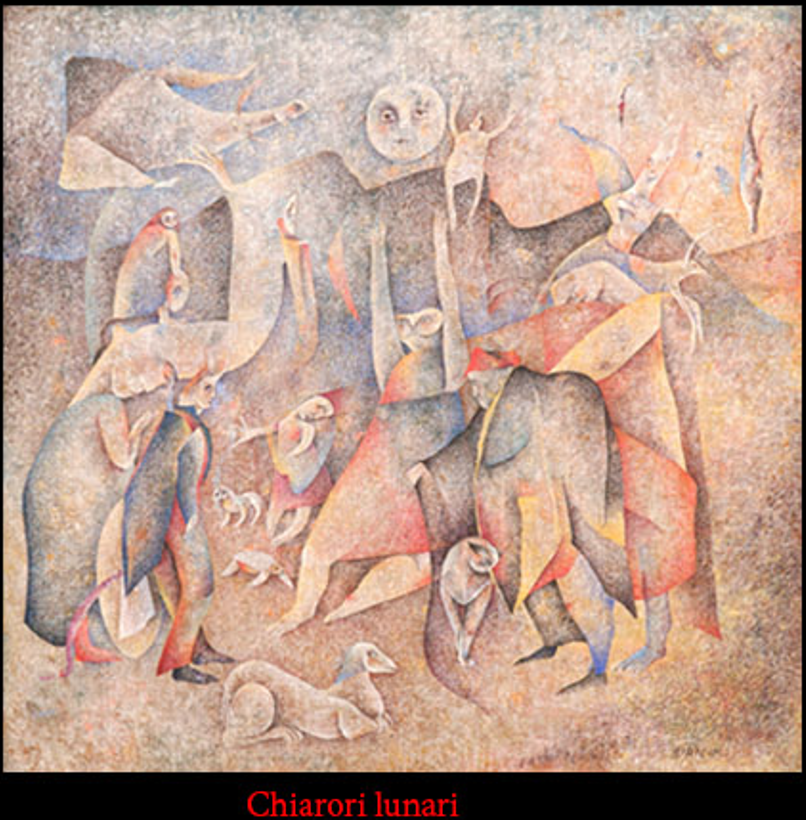
The interior universe of Bianzan
Eduard Wingen
In this postmodern epoch, in which the Transavanguardia is trying with great clamor to avoid the “calm after the storm” of renewal, it is not easy to separate the wheat from the chaff. Only a careful observer can recognize the value of something authentic and unique among the multitude of worn-out, baffed-up images that make the present situation of art so chaotic and opaque. An effort must however be made to verify the observation with the help of one’s knowledge, recollections and, above all, intuition.
An analysis of this kind is rightfully due to the art of Bianzan, who takes her inspiration from a complex interior world. We can see, know and feel that here we are dealing with an art that, by means of interior vibrations, brings to the surface a mysterious world. Bianzan is therefore an artist who, along the lines of Klee’s experience, knows how to make “visible the invisible”, revealing the most hidden secrets of the soul. One who is able to do this also has at her disposal the power of poetry and is still in possession of the innocence that normally is lost after childhood.
The poet-magician Klee well understood the artistic meaning of innocence, and used this pure energy of vision in his images of fantasy. He called the figurative expressions of a child “images of intimate fusion with things, images straining towards the knowledge and penetration of the world”.
An analysis of this kind is rightfully due to the art of Bianzan, who takes her inspiration from a complex interior world. We can see, know and feel that here we are dealing with an art that, by means of interior vibrations, brings to the surface a mysterious world. Bianzan is therefore an artist who, along the lines of Klee’s experience, knows how to make “visible the invisible”, revealing the most hidden secrets of the soul. One who is able to do this also has at her disposal the power of poetry and is still in possession of the innocence that normally is lost after childhood.
The poet-magician Klee well understood the artistic meaning of innocence, and used this pure energy of vision in his images of fantasy. He called the figurative expressions of a child “images of intimate fusion with things, images straining towards the knowledge and penetration of the world”.
According to Klee these images make us relive intense, remote situations, lost experiences that can again be made visible only with great interior effort.
This is exactly what Bianzan calls forth with her “writing of the soul, with the fabulous “gardens” of her imaginary microcosm.
The artist allows the external observer to cast a fleeting eye into the wonderful world of the infinitely small, where elementary forms create new lives and a continuous ferment of rebirth, as in a renewed spring.
Bianzan, as if by benevolent magic, dominates the energies of intuitive thought and makes surprising and enigmatic images appear out of nothing: nocturnal, sidereal, mysterious, capable of communicating the musical dimensions of space. It may seem a contradiction, but the poetry that animates this artist is able to give vastness to her works; her art is the sublimation of the closed interior world which by controlling spiritual energies can reach the infinite.
This is a process that reveals arcane worlds, just as a drop of water under the microscope reveals the invisible secrets of life.
This is exactly what Bianzan calls forth with her “writing of the soul, with the fabulous “gardens” of her imaginary microcosm.
The artist allows the external observer to cast a fleeting eye into the wonderful world of the infinitely small, where elementary forms create new lives and a continuous ferment of rebirth, as in a renewed spring.
Bianzan, as if by benevolent magic, dominates the energies of intuitive thought and makes surprising and enigmatic images appear out of nothing: nocturnal, sidereal, mysterious, capable of communicating the musical dimensions of space. It may seem a contradiction, but the poetry that animates this artist is able to give vastness to her works; her art is the sublimation of the closed interior world which by controlling spiritual energies can reach the infinite.
This is a process that reveals arcane worlds, just as a drop of water under the microscope reveals the invisible secrets of life.
Klee, and also the musical analyst Kandinsky and the dreamer Miro’ brought Bianzan close to these secrets by teaching her to explore her soul, because that is where the mysteries of life take on significance and stimulate the expressive processes of the imagination. And it is because of this searching, this attempt to picture a world that lives beyond apparent reality that Bianzan’s art can be compared to that of the surrealists; but her methods are quite distant from the dogmatism of Breton. At the creative level this artist moves with complete freedom, letting the images appear, guided only by the rhythm of her intelligence and intuition. It is these two qualities that determine the surreal force of her art and allow her to harmoniously fuse rigorous formal language with a magic use of color.
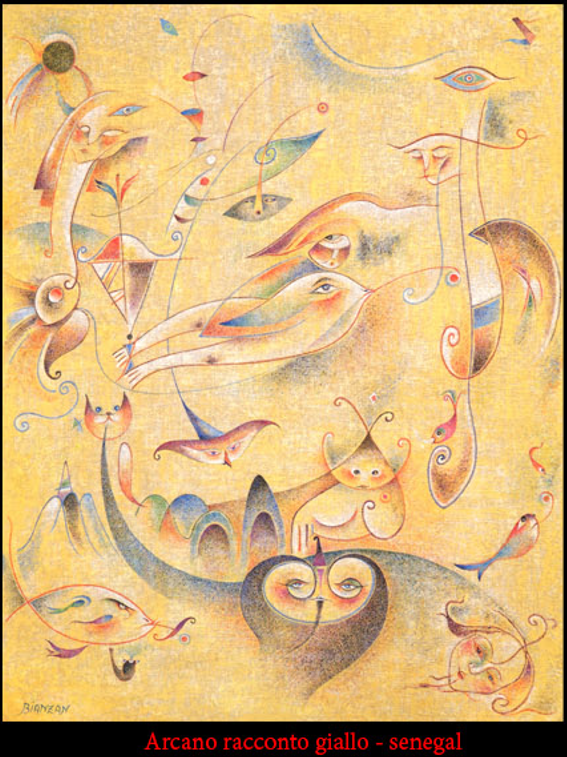
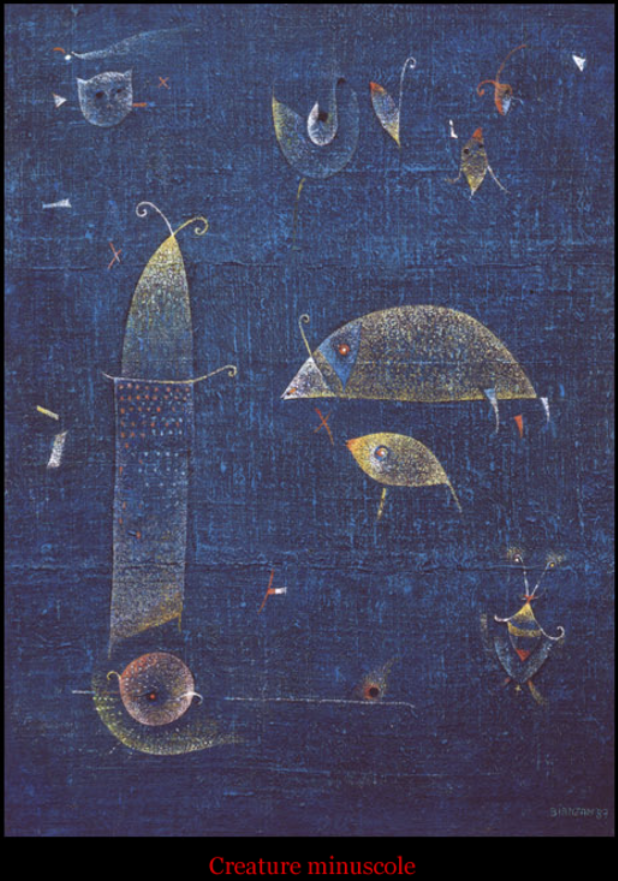
The interior universe that this artist has silently explored over the years and mapped in fantasy creates in the observer a desire to reflect on the present chaotic situation of art, in which superficiality and cynicism now predominate. Only those who still conserve interior values and love the silence of meditation can catch in Bianzan’s art, bound neither to time nor to place, the breath of universality.
Eduard Wingen
Amsterdam
Eduard Wingen, the most influential Dutch art critic and editor of Amsterdam’s “Kunstbeeld,” has published numerous monographs and catalogs on contemporary artists on the Cobra group, Karel Appel, Corneille, Eugène Brands, Theo Wol- vekamp, C.H. Pedersen, Bram van Velde, Marcello Avenali, Aaron Fink and others.

